40 Multi-fandom icons
20 Mar 2026 11:52 am


All icons are HERE at
Note: This post will only be open for a few weeks … after that it will be locked to members only, so please feel free to join/subscribe if you like my work. Thank you.


The Turkish term Gececondu literally translates to "placed overnight." It refers to informal settlements, shantytowns, or slums that emerge without official blessing—typically on the outskirts of major cities and often constructed from waste and makeshift materials. One might expect this in the Middle East, Africa, South America, or developing nations, but is such a thing possible in organized, straight-laced Germany—specifically in Berlin?
It is. However, the unique feature of the Berlin Gececondu is that it owes its existence to the division of the city and the Berlin Wall.
In 1963, Osman Kalin was part of the first wave of so-called "guest workers" who came to Germany following the German-Turkish recruitment agreement. In 1980, he moved to Berlin with his wife and six children, first to Spandau and later to Kreuzberg. Located directly against the Wall was a 350-square-meter triangular wasteland; the plot technically belonged to East Berlin but was located on the West Berlin side of the border.
Starting in 1983, having retired by then, he began clearing the site of rubbish to cultivate vegetables. In the shadow of the Wall, he built a hut out of wardrobe doors, bed frames, and hand-mixed concrete. Initially, East German border guards watched him with deep suspicion, fearing the construction of an escape tunnel. When two VoPo's, policemen from the GDR came to stop him, he was stubbornly pretending not to understand their language and that the land was his property for a long time.
After the fall of the Wall, the Gececondu—or "guerrilla garden," as it is also known—managed to survive for several reasons. On one hand, political leaders appreciated the cultural and folkloric anomaly as a tourist attraction and a symbol of a multicultural, open Berlin; on the other hand, a cash-strapped Berlin lacked the funds to fully restore the Engelbecken (a former canal basin) that once occupied the site.
Thus, Osman was able to grow kale, tomatoes, cherries, and cabbage here until his death in 2018. Today, his son Mehmet and another Turkish family tend to the plot. In writings about the family, one perceives a certain "Anatolian craftiness" and an Eastern interpretation of rules: sympathetic politicians are met with warmth, while inquisitive journalists are often charged a €50 "expense fee" for interviews. Mehmet plans to turn the place into a museum in honor of his father. He charges tourists E5 for visits and has even put up a fake street sign: Osman Kalin Plath 0,1.
The future of the Gececondu is unclear, yet it remains a Berlin curiosity and holds a permanent place in the city's Turkish diaspora.


Cocaine once reigned. But coffee is the king again in Colombia. And as many international tourists are making their way back to the more remote parts of this majestic South American country, the image of Juan Valdez, the “face” of the Colombia coffee grower, is who they want you to remember. Not Pablo Escobar, the face of a Narco industry which fueled a different kind of agriculture which tore this country apart for decades.
In fact, coffee tourism has become THE THING to do in Colombia now. Why? Well, it’s safe to go to the interior of Colombia where small family farms are located but were once riddled with fighting fractions on the left, the military and those just trying to protect their land from narco-trade.
In towns in and around Chinchina, Colombia many small family farms which struggled to survive over the last 30 years are seeing a resurgence of business by opening up their “Fincas,” or plantations/farms to tourists with a full-blown lesson of the production of coffee, a tasting, followed by the visitor getting to pick coffee beans just like the workers on the property. Your beans go into the Colombian “Collectivo,” for coffee production and some farms will even give you a certificate from the Colombian government showing your contribution to the coffee industry.
So proud are the Colombians of this economic stimilant to the region, that in the center of the coffee region they have erected what was at one time the world’s largest coffee mug. It is located at the Parque Principal in Chinchina.
The cup was unveiled for a Guinness Book of Records stunt in June 2019 to fill it with it with the largest cup of coffee in history. They were successful with 22,739.14 litres (5,001.91 UK gal; 6,007.04 US gal). Since it took fifty people and more than a month to construct the project, the cup remains in the plaza for all to behold. (In 2022, a larger cup was unveiled in Leon, Mexico.)
Colombians will admit they are not the largest coffee producers in the world. And their coffee isn’t the strongest. They don’t fetch the highest price on the market for their coffee either. But now that the aggressive years of left- and right-wing fighting seems to be behind them, Colombians may be the proudest of their coffee production. And they have one of the largest coffee cups in the world to prove it now.

The Mola Museum is a must-visit while exploring Panama City. Tucked along a quiet side street in the historic Casco Viejo neighborhood, this intimate museum celebrates the extraordinary textile artistry of the Guna (Kuna) people. Through thoughtfully curated exhibits, visitors gain insight into both the history of the Guna community in Panama and the intricate craft of their traditional textiles, known as molas.
The experience begins with a life-size video installation of a woman dressed in traditional Guna attire, offering a vivid introduction to the culture behind the art. From there, a series of rooms display stunning examples of molas, each accompanied by explanations of their symbolism and meaning. Inspired largely by the natural world around them, Guna artisans create vibrant, layered designs using a meticulous reverse-appliqué technique. Each piece, often composed of two intricately cut and stitched layers, can take anywhere from three days to a week to complete, with many designs telling rich visual stories.
The museum’s collection focuses primarily on works created before 1975, preserving an important chapter of Guna artistic heritage. In addition to the textiles, visitors will also find thoughtfully placed photography that adds further cultural context to this remarkable tradition.

I rarely post about politics. It was a nice thing that we ruined. But occasionally I see interesting things.
Like Alberta’s Wicked Witch of the West indicating she is going through the process to get security cleared so she can be briefed on foreign interference. It’s notable to me because that’s the smart thing to do and she’s not in my mental list of smart people. It also demonstrates to Baby PP how adults handle things rather than making wild claims about being muzzled. Nenshi is behaving like an idiot, though. Can you imagine if politicians decided who could get security clearances?
Speaking of babies, little PP has somehow become several degrees less odious since the con leadership convention. I secretly think Harper had a chat with him about his massive incompetence as party leader, loosing easy election after easy election, including his own seat. He’s MP of Pity Junction, Alberta these days because his Ottawa riding didn’t like how he sided with convoy idiots.
Speaking of convoy idiots, I see that the Feds are appealing the ruling that its use of the Emergencies act to clear that shit show was unconstitutional. I’m not entirely sure that the Feds care if they win, or if it’s more about finding out if the law is even constitutional at all. Or, a second option, the law is constitutional but its use in specific that case was not. Either way, if the ruling goes against them that’ll be a strong indicator that the law needs refining to be applied properly.
That’s it. Happy weekend!

Knowledge is power, but perfect knowledge is impossible.
Suppose you knew when and how you were going to die. Could you avoid crossing the street in front of a speeding taxi? Get a mammogram in time? Stop smoking right now?
You might have to learn to face certain death with aplomb.
Possibly, everything in space and time already exists, just like a museum diorama, unchangeable as the evolution and disappearance of the dinosaurs. Their story began two hundred thirty million years ago, when Thecodonts began to walk upright. It ended 65 million years ago when the eight-ton Tyrannosaurus rex got squashed by a giant asteroid.
Perhaps God has already thought things through. Or perhaps, in an atheistic universe, space-time exists such that all its event-lines are locked in place from beginning to end. For the dinosaurs, it was a fatal surprise when an immense rock from space the size of Halley's Comet smashed into Mexico’s Yucatan Peninsula and blasted out a crater 175 kilometers across.
But it was fate, kismet. The moving finger wrote, and it had to happen. Orbits had intersected, and God, or anyone with a telescope, could have seen it coming.
Philosophers and physicists have propounded for and against this idea of a pre-determined universe. Despite its logical consistency, Western minds can’t quite get around the fatalism. It means that no matter what we do now, we can’t change anything. We are as fierce, beloved, and doomed as T-rex. Our big brains make no difference.
So, you have no free will. You were pre-destined to read this essay, in fact. You can’t change a thing, can you?
Ah, but you have. One small example: Do you remember your school teacher when you were seven years old, Mrs. Sobel? In reality you were nine years old when she was your teacher. Yet you go on blithely making decisions thinking that you live in the seven-year-old-with-Sobel universe.
Mentally, we rearrange events to happen the way we think they should have happened. Then we interact with other people, every one of us with deluded memories, and we change our evolution and redesign our fates en masse.
Worse yet, without monumental research into every moment of your past, you can’t even know what you’ve misremembered. You may have forgotten major events, or made up others out of thin air. You may be planning a vacation to the Yucatan. You hope to swim at the white sand beaches, play a little golf, and take a day trip to the Maya ruins of Uxmal. Or have you already gone? Can you be sure? Was Mrs. Sobel there? Did you see any dinosaurs?
That’s why, in the Yucatan, the ancient Maya wrote down their history. They needed to remember everything that happened because they believed time moved like a wheel, which is why their calendars revolved in circles. Dates would repeat. When time turned around again, if they knew what had happened on the same date the last time, they could be prepared. Their records indicated that huge floods usually destroy the world on a certain date, 13 Baktun 0 Katun 0 Uinal 0 Kin. Fortunately this date doesn’t recur often, most recently on December 23, 2012, by our Gregorian calendar. But was the Earth destroyed? No, because we were prepared!
Knowledge is power. But you have to have accurate information.
And you don’t. You’ve already forgotten who knows what, and so have I.
What’s going to happen next? Somewhere, someone might have known, but we’ve ruined it for them. You may wish to quit smoking, get a mammogram, or look both ways before crossing anyway. We still need all the aplomb we can get, because we will all die, we just can’t know when.
***
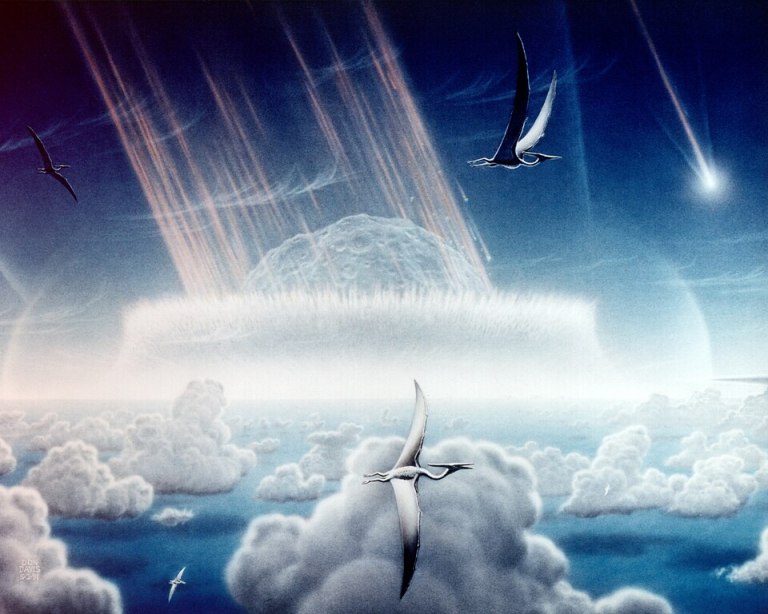
This essay appeared in Issue 2, Summer 2002, of Full Unit Hookup magazine. Illustration: This painting for NASA by Donald E. Davis depicts an asteroid slamming into the Yucatan Peninsula as pterodactyls glide above low tropical clouds.

About 30 miles north of Baker, California, on State Route 127, is an unexpected occurrence: a flowing creek. Salt Creek rises in the Silurian Valley to the south, toward Soda Lake, and flows northward into the Amargosa River as the latter makes a hairpin bend into the southern end of Death Valley. Because the area is extremely arid, both Salt Creek and the Amargosa River flow mostly underground.
Except here, where shallow bedrock forces Salt Creek to the surface, where it follows a channel carved into the bedrock. This occurrence of surface water was obviously of extreme importance to wildlife, not to mention human populations. Indeed, Salt Creek was a stop on the Old Spanish Trail, which connected Los Angeles with Santa Fe (now in New Mexico) in the early 19th century.
Although Salt Creek has the occasional huge flood along it, its channel through the bedrock of the Salt Creek Hills nonetheless seems disproportionate to the size of the creek. It seems that at some times in the Pleistocene the Mojave River flowed through here and carved the channel. At present, the Mojave River is also normally dry. It currently ends at Soda Lake south of Baker. However, exceptionally large flows down the Mojave, such as would occur during extremely wet intervals, would cause Soda Lake to overflow northward into the Salt Creek drainage, and the Mojave would then become an active tributary to the Amargosa.
Until recently tamarisk (Tamarix spp.) trees were abundant along Salt Creek through here, as can be seen in some of the 2006 pictures. This tree is an exotic that has become established throughout the arid West. Because it competes with native vegetation, it is a subject of eradication efforts, and Salt Creek was cleared of tamarisk in the 2010s.
This area also holds the remains of some of the earliest Euro-American mining activity in the Mojave. In the early 1860s gold was struck in the Salt Creek Hills about a mile east of Salt Creek, but miners were driven off and killed by the local Paiutes. Amargosa House, said to be the oldest Euro-American building in the Mojave, dates from this era. It survives as a well-defined ruin today.
Mining had resumed by the 1880s, and a stamp mill (whose ruins survive) was even built. Intermittent activity continued till the early 20th century. Open shafts and adits remain from that era; they have been screened off for safety, but they have not been filled in. Instead they have been covered with coarse steel grates. This is to allow bats access, as abandoned mines have become important habitat for bats.

Krissy and I are on our way to the JoCo Cruise, and as you can tell, we are excited! Well, I am excited, Krissy is, as ever, tolerant. Also I have brought a tiny ukulele, because, after all, is it really a vacation without a tiny ukulele?
Don’t expect too much from me over the next week. Don’t worry, Athena will be around and posting good stuff. As for me, my plan is to get on a boat and not look at the rest of the world for a while. It’s a good plan, which is why I do it annually.
— JS
I’ll be honest, minions: after all these years, I may still be slightly obsessed with Moana? The constant singing, the aggressive YOU'RE WELCOME-ing, the unrequited mooning over a cross-eyed rooster.
Yeah.
SLIGHTLY.
So check this out:
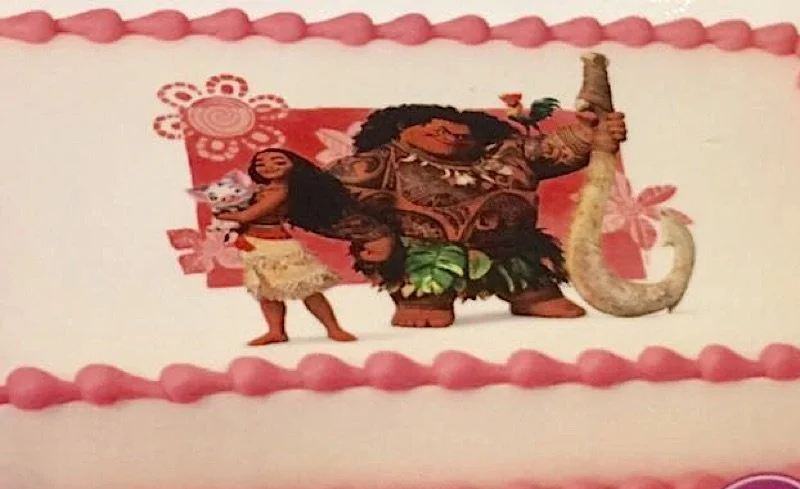
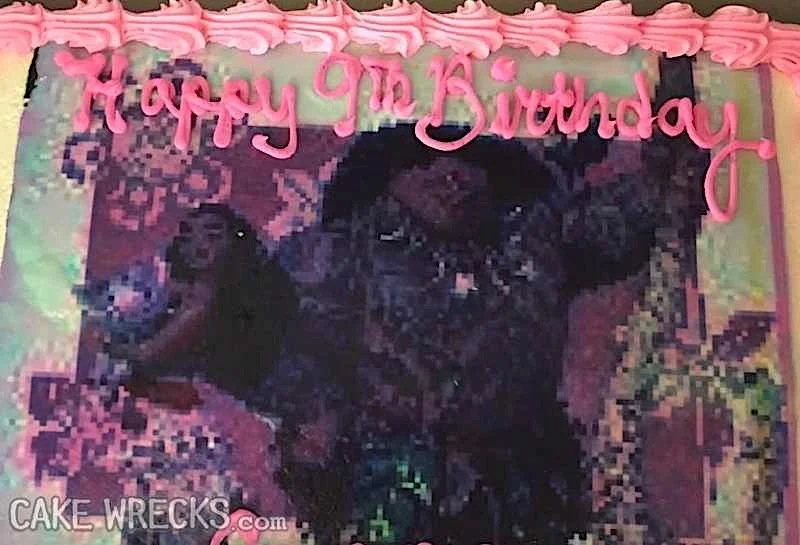
Brandy ordered this Moana cake for her 9-year old, and I think we can all agree it was a wise move. Not only because MOANA, but because it's a printed edible image. That means no guesswork! No drawing! No instructions to fowl up! (HEY HEY ROOSTER SHOUT-OUT)
And yet, as it turns out,
Every turn we take
Every trail we track
Every ordered cake
Every road leads back
to a place we know:
Specifically, the place where a baker insists this is exactly what you ordered and you should totally pay for it.
My thoughts exactly.
Thanks to Brandy L. for providing all the wreckage that's fit to print.
*****
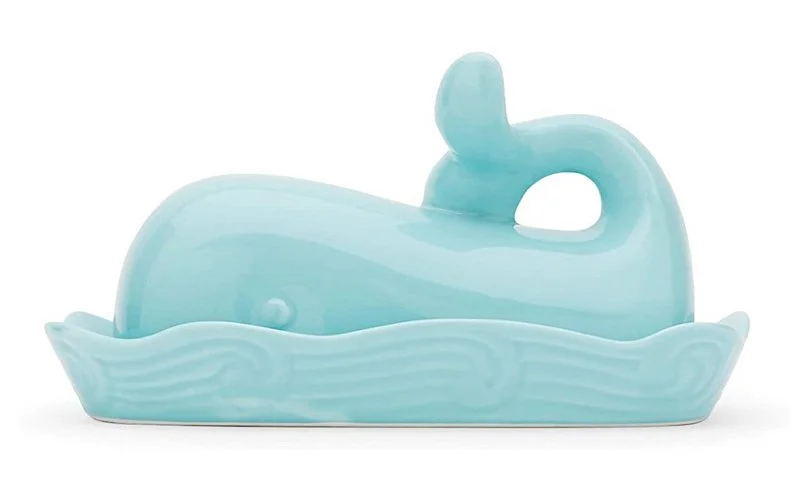
P.S. See the line where the sky meets the sea? IT'S THIS CUTE WHALE DISH:
D'awww. It calls me.
::singing:: And no one knooo-ows, how far it bloooo-ows.
Eh?
******
And from my other blog, Epbot:

1. What was the reason you began a Dreamwidth or LiveJournal account (or both)?
I started LiveJournal in 2002 when a new friend (soon girlfriend) heard me saying that I wanted to write more and suggested LiveJournal. "What's LiveJournal?" I said, and she gave me an invite code, and here I am.
I moved to DW in 2011, I can't remember which exact thing made me do it but it was after Strikethrough, before things got very Russian but I think they were getting pretty Russian.
2. How many DW or LJ communities do you subscribe to?
Five.
3. Do you have a favorite community or one you check out often to see what's new?
I mean, they're all on my reading page. Most are pretty quiet; one I made for covid-cautious people and don't use much myself any more either (its name is a pun based on "herd immunity," that's how old it is...). The best are
thisfinecrew, for U.S. political actions people can taken (often online or relatively low-spoons) and
thissterlingcrew, the British version of the same thing. Very useful communities to have In These Times.
4. How did you pick your user name?
This one was picked by D and another friend (I now cannot remember who) independently when I was looking for a new one.
5. If you could change your user name, would you?
It's clearly from a very specific time in my life, when I was using the name Cosmo and studying linguistics.
As for changing it, I mean, I could. I have. My LJ went through a couple of names too. I almost never re-use user names either; I just use whatever sounds like a good idea at the time. I can barely remember what it was before, and would probably prefer that one now. I did make a concerted effort to get away from puns, things based on my real-life first name, or both; no wonder this is what my friends suggested for me, this is my Brand.
While I'm here, another point I've been meaning to make under this tag for a bit but haven't gotten around to: having been writing about my life for half of it now, I find myself wishing there was a way for tags to become, like, dormant or something. There are lots of tags that I want to keep having but am not going to add new entries to, so I wish I didn't always have to look at them in the list or when I'm choosing tags.
Fandom: Final Fantasy XIV
Rating: Mature
Archive Warnings: Major Character Death
Relationships: Haurchefant Greystone/Warrior of Light, Alphinaud Leveilleur & Warrior of Light, Unrequited Minfilia Warde/Warrior of Light, Unrequited Aymeric de Borel/Warrior of Light, Pre-Urianger Augurelt/Warrior of Light, Alisaie Leveilleur & Warrior of Light, Warrior of Light & Thancred Waters, Y'shtola Rhul & Warrior of Light, Midgardsormr & Warrior of Light, Hydaelyn & Warrior of Light, Urianger Augurelt & Warrior of Light, Minfilia Warde & Warrior of Light, Ardbert & Warrior of Light
Characters: Warrior of Light, Haurchefant Greystone, Alphinaud Leveilleur, Urianger Augurelt, Y'shtola Rhul, Thancred Waters, Emmanellain de Fortemps, Artoirel de Fortemps, Edmont de Fortemps, Alisaie Leveilleur, Minfilia Warde, Midgardsormr (Final Fantasy XIV), Tataru Taru, Ardbert (Final Fantasy XIV), Warriors of Darkness (Final Fantasy XIV), Scions of the Seventh Dawn, Unukalhai (Final Fantasy XIV)
Additional Tags: Grief/Mourning, Survivor Guilt, Elezen Warrior of Light, Female Warrior of Light, Healer Warrior of Ligh, Angst, Suicidal Thoughts, Religious Angst, Depression, Patch 3.0: Heavensward Spoilers (Final Fantasy XIV), Patch 3.4: Soul Surrender Spoilers (Final Fantasy XIV), Canon-Typical Violence
Series: With Lilies and With Laurel
Length: 51,264 / 82,000
Chapter: 10/15
Summary:
A heartbroken Warrior of Light struggles to come to terms with loss, and the world she has been left to save.
Notes:
If you're new here, please start with Chapter 1!
Final Fantasy XIV is owned by Square Enix. This is a non-commercial work of fanfiction.
( Read on AO3 )
( ...or below! )
Previous Chapter | Next Chapter