Hey friends, sorry for the crossposting delay on this one! May is M.E. awareness month & I made an awareness slideshow for my other social media earlier this month. You can find that on
Instagram,
Facebook (which I always forget to link!) and
Google Photos (no IDs). Since the text is identical, I've chosen not to include the images embedded here, but please feel free to consume or share the information in whatever way is best for you.
My M.E. is moderate to severe. It is affected by other conditions, like my hypermobility spectrum disorder, that already cause fatigue. It's why I'm mostly housebound (I get out about twice a month) and mostly bedbound (I sit up only in my wheelchair these days, for limited periods.)
May is M.E. ( myalgic encephalomyelitis ) Awareness Month. Here are some things to be aware of!
M.E. is sometimes called "chronic fatigue syndrome" and you may see the abbreviation ME/CFS
Most people with the diagnosis prefer to use the term M.E., as it more fully encapsulates the disorder. I personally include CFS if I'm posting the abbreviation without more context, because it's a clearer search term.
The name of the disorder means, roughly, muscle pain with brain and spinal cord inflammation.
my = muscle
algic = pain
encephalo = brain
myel = spinal cord
itis = inflammation
People with M.E. have chronic fatigue, but that is BECAUSE of things happening to our bodies, brains, muscles, and immune and nervous systems.
The hallmark symptom of M.E is something called post-exertional malaise (after effort, having feelings of being ill or unwell).
post = after
exertional = effort
malaise = feeling unwell or ill
A hallmark symptom means that this symptom MUST be present for the diagnosis of M.E. to be given. No PEM means no M.E.. I've seen people & organizations say PEM is exclusive to M.E. and that it is not. Full transparency: I do not know which is true.
PEM usually sets in 12 to 48 hours AFTER the exertion that triggers it. It also usually lasts much longer than the initial activity.
Six hours of socializing with a small group of understanding family, including lying down with my eyes closed during the activity, cost me 2+ days fully in bed afterward and triggered other PEM symptoms like a migraine and nausea. Other PEM symptoms include increased cognitive impairment (brain fog), trouble with temperature regulation, trembling, and more.
The "exertion" required to trigger PEM varies across the severity levels of M.E..
In mild M.E., people may be able to do much of the life and leisure activities they always have, but need a lot more recovery time after. In very severe M.E., something as small as speaking out loud, experiencing sensory input like light and sound, or eating can bring on PEM.
Any/all use of cognitive, emotional, OR physical energy can cause PEM.
This means even joyful occasions or mentally taxing activities often bring on PEM. Being too talkative or excited; laughing too hard; being angry; experiencing grief; or focusing on a leisure activity still counts to our systems as an exertion, and requires the same recovery. I live in Minneapolis, and the mental and emotional toll of living through Operation Metro Surge, even on the margins, has made me sicker indefinitely.
Any time we trigger PEM, we may get sicker—indefinitely, or forever.
This is a major part of why people with M.E. don't "just power through," even for events or occasions that are extremely important or exciting for them. Pushing past our carefully maintained limits may make us sicker than we already are; and some people with M.E. are extremely ill already and require assistance with almost everything in their lives.
PEM is not the only type of fatigue people with M.E. experience!
Something I think can get lost when explaining M.E. and PEM is that post-exertional malaise exists ALONGSIDE other types of fatigue and tiredness (hence the "chronic fatigue syndrome" moniker). For me and many other people with M.E., normal activities exhaust us much more & much faster than they should, AND ALSO trigger PEM
Another common symptom of M.E. is unrefreshing sleep, which means we rarely or never feel rested in our brains, bodies, or spirits.
Other Symptoms of M.E. include:
cognitive impairment
frequent fevers
difficulty fighting off infection,
G.I. difficulties
orthostatic intolerance (difficulty standing or even sitting up)
swollen lymph nodes
regular flu-like symptoms
M.E. tends to present with large symptom variations from person to person, so this list is far from exhaustive.
Most people acquire M.E. after having a viral infection like influenza, norovirus, mono, RSV, or COVID-19. This makes M.E. a post-viral illness.
My symptoms sharply increased after a 2022 COVID infection, but it's possible that the first things to trigger my M.E. were a 2009 swine flu infection or three work-acquired norovirus infections between 2012 and 2015.
M.E. is often classified into levels
Mild - usually still able to go to work and perform independent self-care; may not have leisure pursuits and may have difficulty maintaining friendships
Moderate - typically not working or in school; limited in self-care ability & needs rest during the day
Severe - often mostly or entirely homebound; limited daily care tasks; experiencing severe cognitive difficulties & may need a wheelchair
Very Severe - often bed-bound and extremely sensitive to light, sound, & other stimuli. Entirely dependent on care from others.
These categories are a gradient and people can sit between them; I referenced two different ME informational websites for this summary
A combination of illness symptoms like G.I. trouble and system-wide exhaustion triggered by daily care activities means Very Severe M.E. patients may struggle to eat and drink.
Without proper care, including knowledgeable caregivers and proper medical intervention, people with Severe and Very Severe M.E. may die from "simple" things like an inability to eat independently.
There is no medication or treatment that reliably or permanently improves M.E.. Advice for managing life with M.E. is to "radically rest" and use "pacing."
Pacing, in this case, is breaking all tasks up into smaller pieces, stopping before or immediately when signs of exertion show up in your mind or body, and then resting as extremely and as long as you can until you return to your energy baseline.
Suicide and medically-assisted death are common in the M.E. community.
Many people with M.E. describe life as vanishing or shrinking; or describe living with M.E. as anti-life; because all activity often becomes either impossible or further sickening.
So what now?
Now that you're aware, here's some things you can do to support people with M.E.:
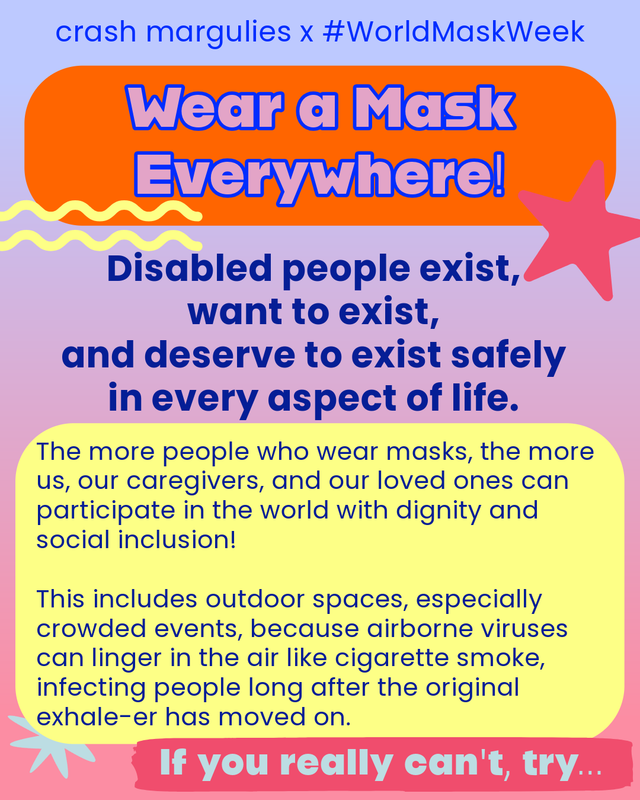
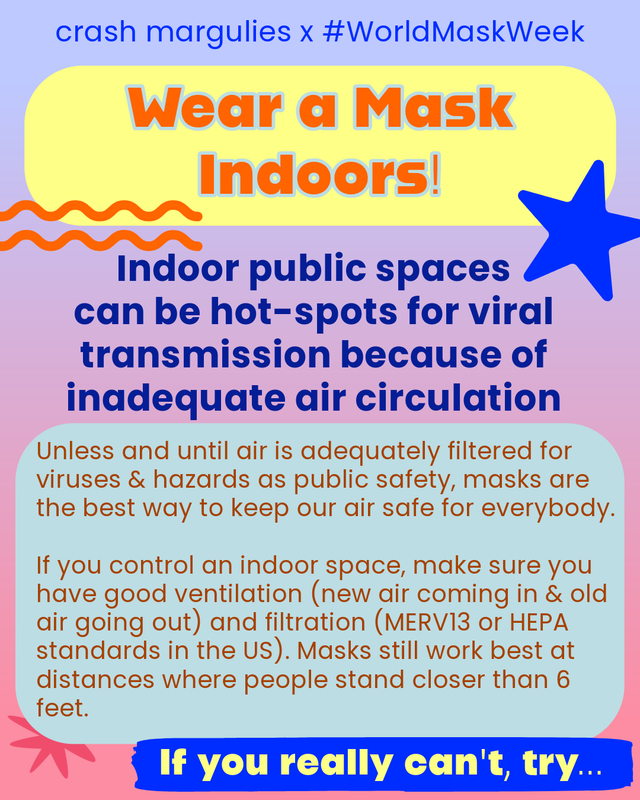
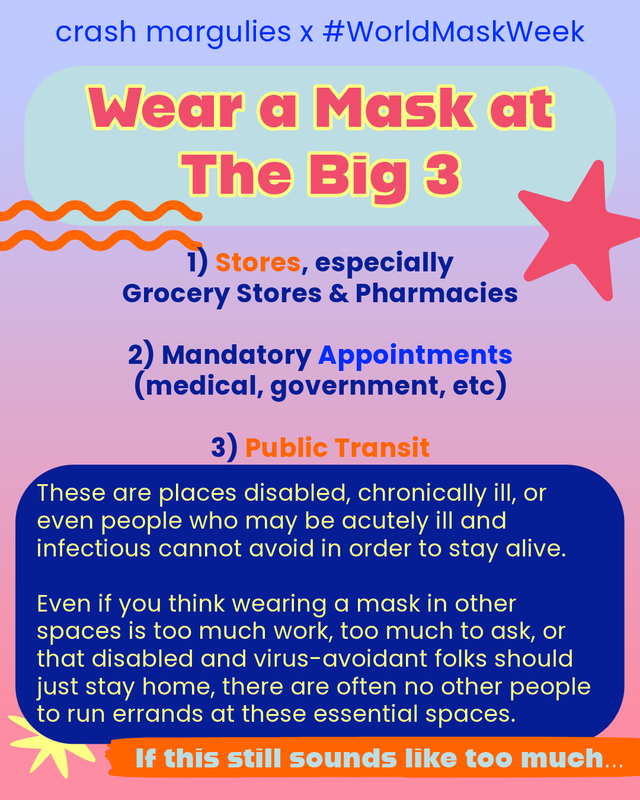
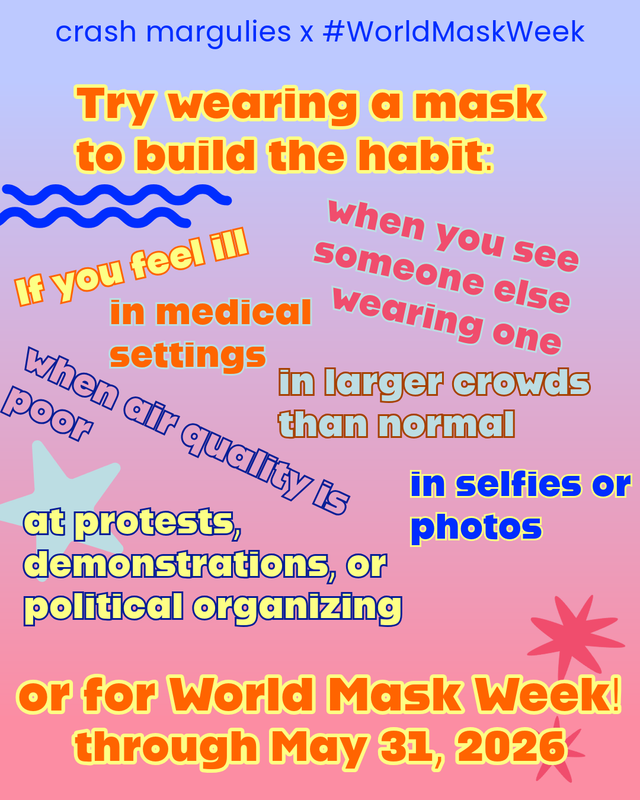
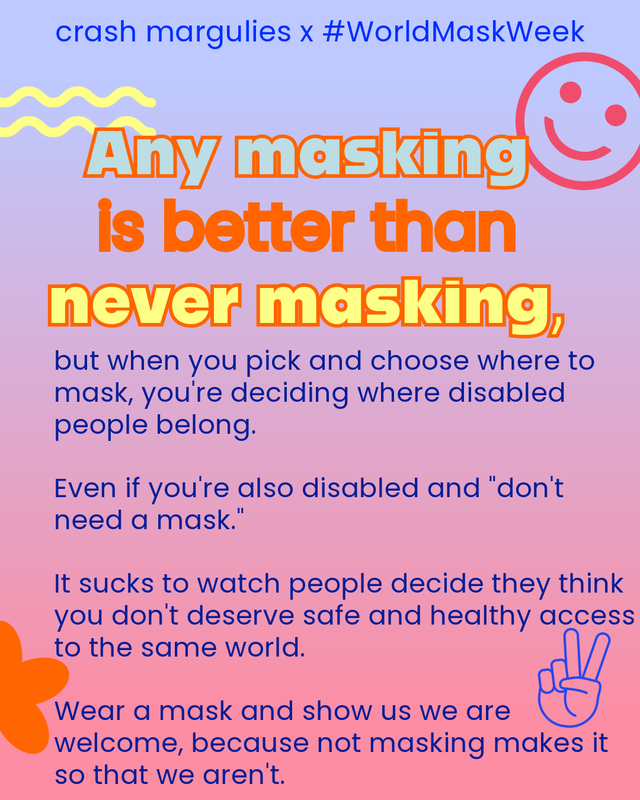
avoid catching & spreading viruses in all the ways you know how, including wearing high-quality masks in all public spaces
support telehealth & other remote medical options, like community paramedics, for house- and bedbound people
stay current with M.E. research & other post-viral illness information, like Long COVID and Epstein-Barr Virus (EBV)
don't abandon friends with energy-limiting symptoms; accept that they may never "pull their weight" in planning or communication
rest your body when ill or tired to avoid making possible mild M.E. worse
![[personal profile]](https://www.dreamwidth.org/img/silk/identity/user.png) peppermint_shamrock posting in
peppermint_shamrock posting in ![[community profile]](https://www.dreamwidth.org/img/silk/identity/community.png) sweetandshort
sweetandshort

![[instagram.com profile]](https://www.dreamwidth.org/img/profile_icons/instagram.png)


![[syndicated profile]](https://www.dreamwidth.org/img/silk/identity/feed.png)